AUG#: +130,000 jobs.

Unemployment up at 3.7%...AUG jobs under Trump HERE

Showing posts with label weekly claims data. Show all posts

Thursday, March 28, 2013

Weekly New Claims Numbers Pop Up

March 2013 reports will be released Friday, April 5th.  Check back then!

Weekly unemployment initial claims popped back up this week after a downward trajectory for the past month.  Unemployment claims have increased two out of the last five weeks. 


First time unemployment jobless claims increased to 357,000  for the week ending March 23rd.   This is an increase of 16,000 but it the first time in a month in which weekly first time initial claims popped above 350,000.  It is unclear whether or not this is a trend, as the Department of Labor also readjusted seasonal adjustments with this week's report.  Weekly claims numbers to date showed that employers were NOT laying people off in response to the sequester.  It's really too soon to tell if this week's claims numbers have any meaning other than the usual weekly volatility.

The four-week moving average # of claims increased by 
2,250 after decreasing by 6,250 last week.  First time claims continue at about the same level that they were in late 2007 to early 2008.  


(Even though these numbers are seasonally adjusted, weekly claims numbers are always a bit volatile and should  only be analyzed in terms of a trend over a period of weeks.  See the graph below.) 


For the week ending March 9th, 5,455,757 people were receiving unemployment benefits under one of the programs that are available (regular state, federal extended unemployment compensation, or a few other smaller programs).  This was an increase of 86,750 continuing claims since the previous week.  The increase in continuing claims occurred in the Federal Extended Unemployment Benefits program (the "Tiers") whereas claims in the Regular State program (the first 20 to 26 weeks of unemployment benefits) decreased 40,000.


Percent of Unemployed People Receiving Benefits decreased to about 43.6% for the week ending March 9th.


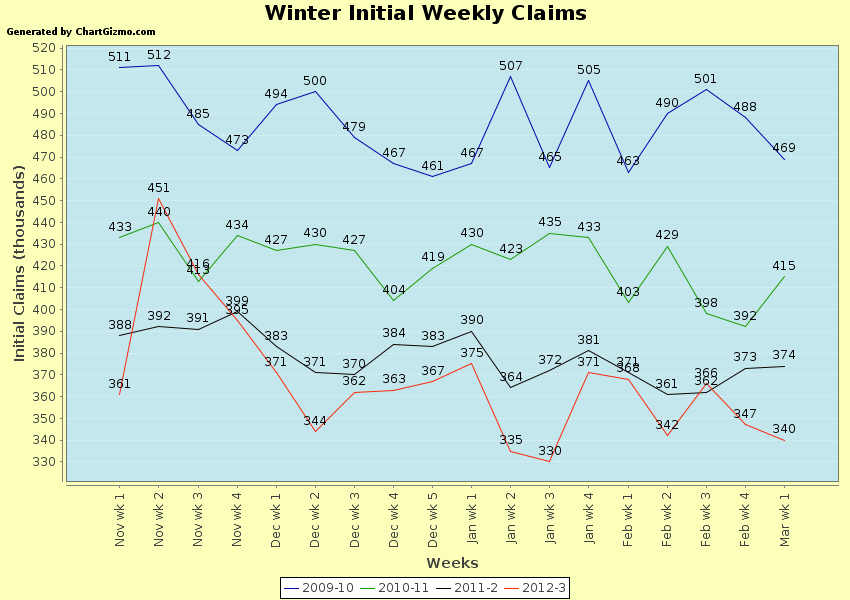
The chart above is one of the BEST charts for understanding and observing changes in the weekly initial claims numbers over time.  This year (red:  2012-13) and the past three years (blue:  2009-10green:  2010-11 and black:  2011-12) are marked in different colors.  You can see that, as a trend, first time claims for unemployment have declined from one year to the next, even though there are variations within the year.  You can also see the impact of Hurricane Sandy on claims in November 2012.  Though the number of initial unemployment claims has been variable over the past three months, it has continued a downward trajectory.  

Be aware that:
  1. The graph above shows first time claims, so people who have continued to receive benefits or who have lost unemployment benefits are not counted in these numbers.  
  2. They are seasonally adjusted, so most variations caused by weather or holidays are already included in these numbers.  
  3. As these are weekly numbers, they are more volatile than the monthly numbers.


First time unemployment claims increased by 16,000 over those reported last week.  Last week's initial claims numbers were revised upwards by  5,000. in seasonally adjusted numbers, but they were only revised upwards by about 1,800 in unadjusted numbers.  There are usually slight upwards revisions  (1,000 to 3,000) in the numbers of initial claims in most of the weeks of the past several months.  Numbers reported this week also reflected changes in seasonal adjustments.  (The chart above shows REVISED claims numbers.)

As usual, to put this into perspective, check out the red line on the chart above to see where jobless claims are now, in late 2012/early 2013, compared to the past three years.

From the current report:
In the week ending March 23, the advance figure for seasonally adjusted initial claims was 357,000, an increase of 16,000 from the previous week's revised figure of 341,000. The 4-week moving average was 343,000, an increase of 2,250 from the previous week's revised average of 340,750.
The initial claims as announced last week were 336,000, so the claims from that week were revised upwards by 5,000. 

Thursday, March 14, 2013

Weekly Unemployment Claims REALLY Down


We have a trend...  Unemployment claims have declined four out of the last five weeks. 


First time unemployment jobless claims decreased to 332,000  for the week ending March 2nd.   This is a decrease of 10,000 but, more important, it appears to mark a solid trend of weekly first time initial claims below 350,000.  It also shows that so far employers are NOT laying people off in response to the sequester; however, as was mentioned last week, the effects of the sequester on employment may occur farther down the road.

The four-week moving average # of claims decreased by 
7,000 after decreasing by 6,750 last week.  First time claims continue at about the same level that they were in late 2007 to early 2008.  


(Even though these numbers are seasonally adjusted, weekly claims numbers are always a bit volatile and should  only be analyzed in terms of a trend over a period of weeks.  See the graph below.) 


For the week ending February 23rd, 5,619,860 people were receiving unemployment benefits under one of the programs that are available (regular state, federal extended unemployment compensation, or a few other smaller programs).  This was an increase of 217,967 continuing claims since the previous week.  The increase in continuing claims occurred in both the Regular State Claims and the Federal Extended Unemployment Benefits program (the "Tiers").


Percent of Unemployed People Receiving Benefits increased to about 45% for the week ending February 23rd.


The chart above is one of the BEST charts for understanding and observing changes in the weekly initial claims numbers over time.  This year (red:  2012-13) and the past three years (blue:  2009-10green:  2010-11 and black:  2011-12) are marked in different colors.  You can see that, as a trend, first time claims for unemployment have declined from one year to the next, even though there are variations within the year.  You can also see the impact of Hurricane Sandy on claims in November 2012.  Though the number of initial unemployment claims has been variable over the past three months, it has continued a downward trajectory.  

Be aware that:
  1. The graph above shows first time claims, so people who have continued to receive benefits or who have lost unemployment benefits are not counted in these numbers.  
  2. They are seasonally adjusted, so most variations caused by weather or holidays are already included in these numbers.  
  3. As these are weekly numbers, they are more volatile than the monthly numbers.


First time unemployment claims decreased by 10,000 over those reported last week.  Last week's initial claims numbers were revised upwards by  2,000.  There are usually slight upwards revisions  (1,000 to 3,000) in the numbers of initial claims in most of the weeks of the past several months.  (The chart above shows REVISED claims numbers.)

As usual, to put this into perspective, check out the red line on the chart above to see where jobless claims are now, in late 2012/early 2013, compared to the past three years.

From the current report:
In the week ending March 9, the advance figure for seasonally adjusted initial claims was 332,000, a decrease of 10,000 from the previous week's revised figure of 342,000. The 4-week moving average was 346,750, a decrease of 2,750 from the previous week's revised average of 349,500.


The initial claims as announced last week were 340,000, so the claims from that week were revised upwards by 2,000. 

Current January/February/March Initial Claims Continue to be the Lowest Since Late 2007/Early 2008.

As a whole, the current numbers of initial claims continue to be the lowest Winter initial claims numbers since late 2007/early 2008.
  

Continuing regular state claims, from people who are continuing to claim unemployment through the initial 20 to 26 week regular unemployment program, declined 89,000 for the week ending March 2nd after increasing 3,000 the week before.  3,024,000 people filed continuing regular state claims in the week ending March 2nd.  As a whole, continuing regular claims continue to decline despite some individual weekly increases.  (There were 3,394,000 continuing claims a year ago.) 

Total number of people receiving unemployment insurance is 45% of the officially unemployed for the week ending February 23rd.  

The weekly report also tells us the total number of people who are receiving unemployment benefits.  For the week ending February 23rd, 5,619,860 people were receiving unemployment benefits under one of the programs that are available (regular state, extended benefits, federal extended unemployment compensation, or a few other smaller programs).  This compares with 12,500,000 people who are unemployed in unadjusted numbers according to the monthly February unemployment situation report which was released Friday, March 8th.  Those numbers, showing that only 45% of the officially unemployed are receiving benefits, should make it clear that people do NOT need to be receiving unemployment insurance to be counted among the unemployed.  (This ratio and these two numbers are NOT seasonally adjusted.)

Extended Benefits (EB) Only Available in Alaska


Extended Benefits claims were only available in Alaska during the week ending February 23rd.  

As of the week ending February 23rd, only 549 people were still receiving Extended Benefits, as mentioned above.  As recently as late April 2012, 350,579 people were receiving Extended Benefits.  A year ago, 453,300 people were receiving Extended Benefits.

Therefore, over the last ten months, 99.8% of the people who were receiving Extended Benefits are no longer receiving such benefits.  We do not know how many of these 350,000 people found jobs, how many have another source of income in the family, and how many have nothing. 

To reiterate, while a decrease in the number of people FILING for initial claims is a good thing and indicates that fewer people are being laid off, a decrease in the TOTAL number of people getting unemployment insurance may only show that fewer people are eligible for unemployment insurance benefits.

Any questions or confusion, please leave a comment or email me!


Thursday, March 7, 2013

Unemployment Claims DOWN: A Trend?!


We may have a trend...  Unemployment claims decline three out of the last four weeks.


First time unemployment jobless claims decreased to 340,000  for the week ending March 2nd.   This is a decrease of 7,000 but it appears to mark a solid trend of weekly first time initial claims in the 340,000's (vs. jumping back and forth and up and down about 30,000 claims a week).  It also shows that so far employers are NOT laying people off in response to the sequester; however, the effects of the sequester on employment may occur farther down the road.

The four-week moving average # of claims decreased by 
7,000 after decreasing by 6,750 last week.  First time claims continue at about the same level that they were in late 2007 to early 2008.  The four-week moving average # of claims has not been this low since the week ending March 8, 2008.


(Even though these numbers are seasonally adjusted, weekly claims numbers are always a bit volatile and should  only be analyzed in terms of a trend over a period of weeks.  See the graph below.) 


For the week ending February 16th, 5,401,893 people were receiving unemployment benefits under one of the programs that are available (regular state, federal extended unemployment compensation, or a few other smaller programs).  This was a decrease of 362,275 continuing claims since the previous week.  The decrease in continuing claims was almost exclusively in claims in the Federal Extended Unemployment Benefits program (the "Tiers"), which accounted for about 60% of the decrease in continuing claims.


Percent of Unemployed People Receiving Benefits decreased to about 43.2%.


The chart above is one of the BEST charts for understanding and observing changes in the weekly initial claims numbers over time.  This year (red:  2012-13) and the past three years (blue:  2009-10green:  2010-11 and black:  2011-12) are marked in different colors.  You can see that, as a trend, first time claims for unemployment have declined from one year to the next, even though there are variations within the year.  You can also see the impact of Hurricane Sandy on claims in November 2012.  Though the number of initial unemployment claims has been variable over the past three months, it has continued a downward trajectory.  

Be aware that:
  1. The graph above shows first time claims, so people who have continued to receive benefits or who have lost unemployment benefits are not counted in these numbers.  
  2. They are seasonally adjusted, so most variations caused by weather or holidays are already included in these numbers.  
  3. As these are weekly numbers, they are more volatile than the monthly numbers.


First time unemployment claims decreased by 7,000 over those reported last week.  Last week's initial claims numbers were revised upwards by  3,000.  There are usually slight upwards revisions  (1,000 to 3,000) in the numbers of initial claims in most of the weeks of the past several months.  (The chart above shows REVISED claims numbers.)

As usual, to put this into perspective, check out the red line on the chart above to see where jobless claims are now, in late 2012/early 2013, compared to the past three years.

From the current report:
In the week ending March 2, the advance figure for seasonally adjusted initial claims was 340,000, a decrease of 7,000 from the previous week's revised figure of 347,000. The 4-week moving average was 348,750, a decrease of 7,000 from the previous week's revised average of 355,750.
The initial claims as announced last week were 344,000, so the claims from that week were revised upwards by 3,000. 

Current January/February/March Initial Claims Continue to be the Lowest Since Late 2007/Early 2008.

As a whole, the current numbers of initial claims continue to be the lowest January/February/March initial claims numbers since late 2007/early 2008.
  

Continuing regular state claims, from people who are continuing to claim unemployment through the initial 20 to 26 week regular unemployment program, increased 3,000 for the week ending February 23rd after decreasing 91,000 the week before.  3,094,000 people filed continuing regular state claims in the week ending February 23rd.  As a whole, continuing regular claims continue to decline despite some individual weekly increases.  (There were 3,436,000 continuing claims a year ago.) 

Total number of people receiving unemployment insurance is 41% of the officially unemployed for the week ending February 16th.  

The weekly report also tells us the total number of people who are receiving unemployment benefits.  For the week ending February 16th, 5,401,893 people were receiving unemployment benefits under one of the programs that are available (regular state, extended benefits, federal extended unemployment compensation, or a few other smaller programs).  This compares with 12,500,000 people who are unemployed in unadjusted numbers according to the monthly February unemployment situation report which was released Friday, March 8th.  Those numbers, showing that only 43.2% of the officially unemployed are receiving benefits, should make it clear that people do NOT need to be receiving unemployment insurance to be counted among the unemployed.  (This ratio and these two numbers are NOT seasonally adjusted.)

Extended Benefits (EB) Only Available in Alaska


Extended Benefits claims were only available in Alaska during the week ending February 16th.  

As of the week ending February 16th, only 555 people were still receiving Extended Benefits, as mentioned above.  As recently as late April 2012, 350,579 people were receiving Extended Benefits.  A year ago, 473,762 people were receiving Extended Benefits.

Therefore, over the last ten months, 99.8% of the people who were receiving Extended Benefits are no longer receiving such benefits.  We do not know how many of these 350,000 people found jobs, how many have another source of income in the family, and how many have nothing. 

To reiterate, while a decrease in the number of people FILING for initial claims is a good thing and indicates that fewer people are being laid off, a decrease in the TOTAL number of people getting unemployment insurance may only show that fewer people are eligible for unemployment insurance benefits.

Any questions or confusion, please leave a comment or email me!


Thursday, July 19, 2012

Weekly Initial Unemployment Claims Jump (July 14, 2012)

First time unemployment jobless claims increase by 34,000 for week ending July 14th.  Despite this increase, the four-week moving average # of claims decreased  by 1,500.


For the week ending June 30th, 5,752,116 people are receiving unemployment benefits under one of the programs that are available (regular state, extended benefits, federal extended unemployment compensation, or a few other smaller programs). 

Percent of Unemployed People Receiving Benefits drops to
45.1%.


Extended Benefits claims continue to decline by another 6.5% as fewer people from fewer states are eligible for Extended Benefits.  Only 7.6%  of the number of people who were receiving Extended Benefits a year ago are receiving Extended Benefits this year.


First time unemployment claims increased by a substantial 34,000 over those reported last week.  Last week's claims were revised upwards by 2,000.  The four-week moving average decreased by 1,500.  This is the first week of increases after three weeks of declines.  As a whole, claims have been stable this spring and summer except for the last two weeks.  There have been slight upwards revisions in the initial claims numbers in nine out of the last ten weeks.  (The chart below shows REVISED claims numbers.)


As usual, to put this into perspective, check out the red line on the chart below to see where jobless claims are now, in spring and early summer of 2012, compared to spring and early summer of the past three years.

From the current report:


In the week ending July 14, the advance figure for seasonally adjusted initial claims was 386,000, an increase of 34,000 from the previous week's revised figure of 352,000. The 4-week moving average was 375,500, a decrease of 1,500 from the previous week's revised average of 377,000

The initial claims as announced last week were 350,000, so the claims from that week were revised upwards by 2,000. 


The chart above is one of the BEST charts for understanding and observing changes in the weekly initial claims numbers over time.  This year (red-2012) and the past three years (blue- 2009green- 2010 and black- 2011) are marked in different colors.  You can see that, as a trend, first time claims for unemployment have gone down SIGNIFICANTLY from one year to the next, even though there are variations within the year.  

Be aware that:

  1. These are first time claims, so people who have continued to receive benefits or who are losing any unemployment benefits would not be counted in these numbers.  
  2. They are seasonally adjusted, so most variations caused by weather or holidays are already included in these numbers.  
  3. As these are weekly numbers, they are more volatile than the monthly numbers.

Current Spring-summer Initial Claims Lowest Since 2008; Historical Claims Data Below

As a whole, the current numbers of initial claims continue to be the lowest spring-summer initial claims numbers since 2008, as can be seen on the chart above.  

Average initial claims for this time of year for earlier years include:

  • June-early July 2000:  289,000
  • June-early July 2001:  388,000
  • June-early July 2002:  388,000 
  • June-early July 2003:  424,000
  • June-early July 2004:  344,000
  • June-early July 2005:  326,000 
  • June-early July 2006:  308,000
  • June-early July 2007:  317,000
  • June-early July 2008:  382,500

    Mid June-early July 2012 4-week moving average:  375,500 

Continuing regular state claims, from people who are continuing to claim unemployment through the initial 20 to 26 week regular unemployment program, increased 1,000 for the week ending July 7th after decreasing by 5,000 week before.  3,314,000 people filed continuing regular state claims in the week ending July 7th.  As a whole, continuing regular claims continue to decline despite some individual weekly increases.  (There were 3,727,000 continuing claims a year ago.) 

Total number of people receiving unemployment insurance decreased slightly to 45.1% of officially unemployed for the week ending June 30th.  

The weekly report also tells us the total number of people who are receiving unemployment benefits.  For the week ending June 30th, 5,752,116 people are receiving unemployment benefits under one of the programs that are available (regular state, extended benefits, federal extended unemployment compensation, or a few other smaller programs).  This compares with 12,749,000 people who are unemployed according to the monthly June unemployment situation report which was released last week.  Those numbers, showing that only 45.1% of the officially unemployed are receiving benefits, should make it clear that people do NOT need to be receiving unemployment insurance to be counted among the unemployed.

Extended Benefits Expire; 6.5% Fewer People Receive Extended Benefits

As we've been mentioning, many states have now "triggered" off of Extended Benefits.  There are now only 4 states in which Extended Benefits were still available.  Those states were:  Rhode Island, Idaho, Nevada, and New Jersey.  All other states have triggered off of Extended Benefits.

Rhode Island, Nevada, and New Jersey will trigger off of Extended Benefits as of the second week of July.  The only state left with Extended Benefits as of mid-July will be Idaho.

As of the week ending June 23rd, 43,972 people were still receiving Extended Benefits.  However, for the week ending June 30th, this number declined to 41,108, a reduction of about 6.5%.  I mentioned last month that we could expect that the total number of people receiving unemployment benefits would decline to below 6,000,000 as Extended Benefits expire, which did happen several weeks ago.  In late April, 350,579 people were receiving Extended Benefits.

In two months, 88.3% of the people who were receiving Extended Benefits are no longer receiving such benefits.  We do not know how many of these 309,471 people found jobs or how many have another source of income. 

To reiterate, while a decrease in the number of people FILING for initial claims is a good thing and indicates that fewer people are being laid off, a decrease in the TOTAL number of people getting unemployment insurance may only show that fewer people are eligible for unemployment insurance benefits.

Any questions or confusion, please leave a comment or email me!

Thursday, May 31, 2012

Weekly Unemployment Claims Increase

First time unemployment jobless claims increase by 10,000... and the four-week moving average increases by 3,750.


First time unemployment claims increased by 10,000 over those reported last week.  The four-week moving average increased (3,750) as well, though it didn't increase as much as the four-week moving average decreased last week (5,500).  As a whole, claims have been stable this spring, but they have tended slightly up over the past four weeks, with slight upwards revisions every week.


As usual, to put this into perspective, check out the red line on the chart below to see where jobless claims are now, in spring of 2012, compared to spring of the past three years.

From the current report:


In the week ending May 26, the advance figure for seasonally adjusted initial claims was 383,000, an increase of 10,000 from the previous week's revised figure of 373,000. The 4-week moving average was 374,500, an increase of 3,750 from the previous week's revised average of 370,750.
The initial claims as announced last week were 370,000, so the claims from that week were revised upwards by 3,000. 


The chart above is one of the BEST charts for understanding and observing changes in the weekly initial claims numbers over time.  This year (red-2012) and the past three years (blue- 2009, green- 2010 and black- 2011) are marked in different colors.  You can see that, as a trend, first time claims for unemployment have gone down SIGNIFICANTLY from one year to the next, even though there are variations within the year.  


Be aware that:  1.  These are first time claims, so people who have continued to receive benefits or who are losing any unemployment benefits would not be counted in these numbers.  2.  They are seasonally adjusted, so most variations caused by weather or holidays are already included in these numbers.  3.  As these are weekly numbers, they are more volatile than the monthly numbers.

The current numbers of initial claims continue to be the lowest springtime initial claims numbers since 2008.  Continuing regular state claims, from people who are continuing to claim unemployment through the initial 20 to 26 week regular unemployment program, has continued to drop.  In the week ending May 12th, in unadjusted numbers, they dropped to 3,117,110 from 3,141,342.

Total number of people receiving unemployment insurance decreases.


The weekly report also tells us the total number of people who are receiving unemployment benefits.  For the week ending May 12th, 6,137,862 people are receiving unemployment benefits under one of the programs that are available (regular state, extended benefits, federal extended unemployment compensation, or a few other smaller programs).  This compares with 12,500,000 people who are unemployed according to the monthly April unemployment situation report which was released earlier in the month.  (The May numbers will be released tomorrow, June 1st.)  Those numbers, showing that less than half the officially unemployed are receiving benefits, should make it clear that people do NOT need to be receiving unemployment insurance to be counted among the unemployed.

Extended Benefits Expire


Many states have now "triggered" off of Extended Benefits.  Extended Benefits for those states, including California, Illinois, Florida, and several others, were due to end the weekend of May 12th.  On the current weekly report, as of the week ending May 12th, 312,434 people were still receiving Extended Benefits.  However, this number should decrease significantly as Extended Benefits have expired or are expiring for people in many states.  We can expect that the total number of people receiving unemployment benefits will declined to below 6,000,000 due to the end of those benefits.  


So, while a decrease in the number of people filing for initial claims is a good thing and indicates that fewer people are being laid off, a decrease in the total number of people getting unemployment insurance may only show that fewer people are eligible for unemployment insurance benefits.

Any questions or confusion, please leave a comment or email me!

Thursday, May 17, 2012

Weekly Initial Unemployment Claims Unchanged (Week ending 5/12)

Initial Unemployment Claims Week Ending 5/19 HERE!


First time unemployment claims stable (Week ending 5/12).


First time unemployment claims were the same as reported last week, though the four-week moving average has decreased.  Claims have been stable this spring, as seen on the attached chart.

From the current report:

In the week ending May 12, the advance figure for seasonally adjusted initial claims was 370,000, unchanged from the previous week's revised figure of 370,000. The 4-week moving average was 375,000, a decrease of 4,750 from the previous week's revised average of 379,750.
The initial claims announced last week were 367,000, so the claims from that week were revised upwards by 3,000. 


The chart above is one of the BEST charts for understanding and observing changes in the weekly initial claims numbers over time.  This year (red-2012) and the past two years (green- 2011 and blue- 2010) are marked in different colors.  You can see that, as a trend, first time claims for unemployment have gone down SIGNIFICANTLY from one year to the next, even though there are variations within the year.  


Be aware that:  1.  These are first time claims, so people who have continued to receive benefits or who are losing any unemployment benefits would not be counted in these numbers.  2.  They are seasonally adjusted, so most variations caused by weather or holidays are already included in these numbers.  3.  As these are weekly numbers, they are more volatile than the monthly numbers.

You an also see that the April bulge, visible during the 1st-2nd week of April in all three years, has ended in 2012, with a return to first time claims levels of March.  As a comparison, the initial claims in April were around 260,000 in the year 2000, and about 300,000 in 2006 and 2007.  The current numbers of initial claims are the lowest springtime initial claims numbers since 2008.

The weekly report also tells us the number of people who are receiving unemployment benefits.  For the week ending April 21st, 6,273,624 people are receiving unemployment benefits under one of the programs that are available (regular state, extended benefits, federal extended unemployment compensation, or a few other smaller programs).  This compares with 12,500,000 people who are unemployed according to the monthly April unemployment situation report which was released last week.  Those numbers, showing that only half the officially unemployed are receiving benefits, should make it clear that people do NOT need to be receiving unemployment insurance to be counted among the unemployed.

Extended Benefits Expire


Many states have now "triggered" off of Extended Benefits.  Extended Benefits for those states, including California, Illinois, Florida, and several others, were due to end last weekend on May 12th.  On the current weekly report, as of the week of April 28th, 305,000 people are still receiving Extended Benefits.  However, within three weeks, we would expect to see the numbers of people receiving unemployment benefits in total and Extended Benefits in particular decline due to the end of those benefits.  So, while a decrease in the number of people filing for initial claims is a good thing and indicates that fewer people are being laid off, a decrease in the total number of people getting unemployment insurance may only show that fewer people are eligible for unemployment insurance benefits.

Any questions or confusion, please leave a comment or email me!

Thursday, May 10, 2012

Weekly Initial Unemployment Claims Numbers Stabilize

First time unemployment claims decrease.


First time unemployment claims dipped slightly, but are now stable over the last couple of months, as shown by the attached chart.  From the current report:
In the week ending May 5, the advance figure for seasonally adjusted initial claims was 367,000, a decrease of 1,000 from the previous week's revised figure of 368,000. The 4-week moving average was 379,000, a decrease of 5,250 from the previous week's revised average of 384,250. 


A few comments:  1.  These are first time claims, so people who have continued to receive benefits or who are losing any unemployment benefits would not be counted in these numbers.  2.  They are seasonally adjusted, so most variations caused by weather or holidays are already included in these numbers.  3.  As these are weekly numbers, they are more volatile than the monthly numbers.


The chart above is the BEST chart for understanding and observing changes in the weekly initial claims numbers over time.  This year (red-2012) and the past two years (green- 2011 and blue- 2010) are marked in different colors.  You can see that, as a trend, first time claims for unemployment have gone down SIGNIFICANTLY from one year to the next, even though there are variations within the year.  

You an also see that the April bulge, visible during the 1st-2nd week of April in all three years, has ended in 2012, with a return to first time claims levels of March.  For reference, the initial claims in April were around 260,000 in the year 2000, and about 300,000 in 2006 and 2007.  These are the lowest springtime initial claims numbers since 2008.

The weekly report also tells us the number of people who are receiving unemployment benefits.  For the week ending April 21st, 6,423,383 people are receiving unemployment benefits under one of the programs that is available (regular state, extended benefits, federal extended unemployment compensation, or a few other smaller programs).  This compares with 12,500,000 people who are unemployed according to the monthly April unemployment situation report which was released last week.  Those numbers, showing that only half the officially unemployed are receiving benefits, should make it clear that people do NOT need to be receiving unemployment insurance to be counted among the unemployed.

Any questions or confusion, please leave a comment or email me!